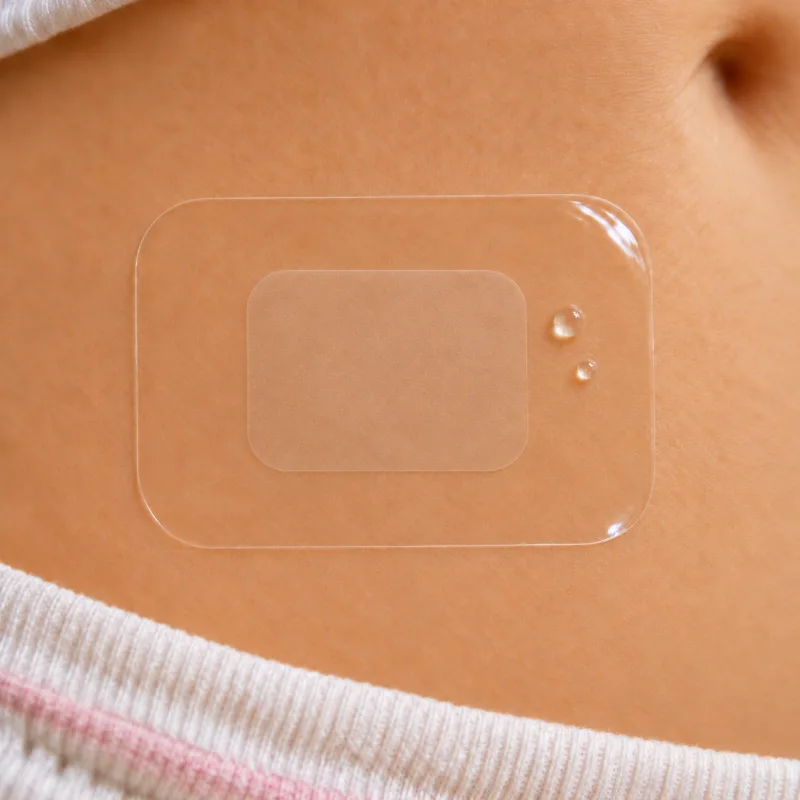
As a biomedical engineering student, I spend a lot of time thinking about the place where a material meets skin. What sticks, what breathes, what moves through. So when I learned how many people quietly fight their hormone patch every week, peeling corners, patches lost in the shower, that gray ring left behind, I saw an engineering problem worth solving.
Covering a patch has become a popular fix, and it’s a question I see come up a lot on social media: is it actually a good idea? The answer comes down to one thing most people never think about. Not all covers are made the same.
Why a patch that stays put matters
An estradiol patch is a thin sandwich: an adhesive layer that holds the medication, topped by a backing film that keeps the estradiol moving in one direction, into your skin. How well it works depends on how much of it stays in firm contact with you.
That’s why adhesion isn’t just cosmetic. The FDA requires patch makers to test it, because when a patch loses adhesion, “the amount of drug delivered to the patient may be reduced.” A lifted edge is less contact. A patch lost in the shower is a gap until you notice.
The difference between a cover and the right cover
Here’s the part that gets lost online. The concern with covering a patch has always been about airtight materials, like plastic bandages or vinyl tape. Skin that’s sealed with no way for moisture to escape gets overly hydrated, and that can change how things move through it.
A breathable film is a different story. The UK’s NHS Specialist Pharmacy Service, which writes medicines guidance for the National Health Service, makes exactly this distinction. It advises against occlusive (airtight) dressings, and lists a non-occlusive transparent dressing over the patch as an option when a patch won’t stick. In its own words:
“Any brand of dressing can be used to cover a patch as long as it is non-occlusive and transparent.”
NHS Specialist Pharmacy Service
UK pediatric guidance for estradiol patches likewise suggests a clear film dressing to help patches stick.
That line, breathable and transparent, is the line Lovelet was designed around.
How Lovelet is engineered
- Breathable film. Lovelet uses a medical-grade polyurethane film that lets water vapor out while keeping water in the shower out. Breathability is measured as moisture vapor transmission rate, and our film is rated at about 621 g/m² per 24 hours, faster than resting skin typically releases moisture.
- Thinner than paper. At around 20 microns, the film is flexible and barely there. It moves with your skin instead of tugging at it.
- Sized to your patch. General-purpose wound dressings come in big sheets. Each Lovelet cover is cut to extend just past the edge of your specific patch, so it covers as little extra skin as possible.
- Completely clear. You can always see your patch underneath, which pharmacy guidance recommends so a patch can be checked and identified at a glance.
A quick word on heat
Heat can increase how quickly many patch medications are absorbed, which is why patch instructions suggest letting your skin cool after a shower before applying a new one. A thin film isn’t a heat source, but the usual patch advice still applies with or without a cover: keep heating pads, heated seats and hot tubs away from your patch.
Is a cover right for you?
Lovelet is made for people whose patches peel, curl or come off. If yours already stays on through everything, you may not need one. And because every body and every prescription is a little different, it’s always worth checking with your prescriber or pharmacist before covering a patch, especially if you have sensitive skin or are adjusting your dose.
If you ever notice anything unusual after using a cover, such as your symptoms returning, breast tenderness, unexpected bleeding, or redness, itching or rash on your skin, stop using it and contact your doctor.
What’s next
We’re continuing to test Lovelet in real-world, full-week wear, and we’ll keep sharing what we learn here in the Journal.
Women’s health has waited a long time for this kind of attention. Too often, women have been left to make do with tape, bandages and products designed for something else entirely. We believe the people wearing these patches deserve the same engineering rigor and care as anything else in medicine, built for them from the very start.
A better patch cover is where we’re beginning, not where we’ll stop. We’re excited for what comes next, and we hope you’ll come along with us.